
Forschungsergebnisse
19.07.2004
Quelle: |
Autor |
Verfasser |
Aires Gameiro, Director, São João de Deus Mental
Health Center, Funchal, Madeira / Past-Director, Mental Health Center of São Miguel, Azores |
Thema: |
Identity Formation and Risk Factors for Azorean Women’s Health |
This paper, presented at the Conference Women in the Azores and the
Immigrant Communities held in July of 2001, analyzes some current problems
related to the personal identity formation and social integration of Azorean
women in relation to stress and substance abuse. It deals with psychosocial and
cultural factors, specially those that are more significant to the development
of personal identity. The cultural and conflictual fragmentation so
characteristic of this Post-modern period generates not only freedom to make
choices, but also the tendency toward stress and dependencies. The current
situation of women is analyzed in relation to these two tendencies. Also
highlighted are the added difficulties of about 5% of the population affected by
genetic and environmental factors. Current cultural trends are considered as a
source of opportunities and risks for women, since they can enrich the process
of personal and social identity formation or promote risky consumption and
jeopardize this process. The third part presents other sources and data related
to the risky consumption of alcohol, tobacco and drugs in the Azores. Three
situations are emphasized: women as victims of the consumption of others; women
as victims of their own consumption and women as victimizing others due to their
habits. The conclusion proposes more research on risky consumptive behavior and
the implementation of a system of preventive measures.
1.
Factors Leading to Stress in Identity Formation and Social Integration
The
development of personal and social identity is a complex personal process, which
is at times intuitive-affective, and at others verbalized, and which involves:
•
personal
enrichment through
the development of new knowledge and values.
•
affirmation
of differences related
to other persons and groups.
•
affirmation
of similarities that
are favourable to one’s self-image.
•
affirmation
of one’s own qualities .
•
exclusion
of what is considered negative.
•
affirmation-integration
of the
qualities and values of the group or groups one belongs to or wishes to belong
to (See Table 1).

Aires
Gameiro, 2001.
The
attitudes, behaviour, and values of significant persons and groups, and the
recognition of primary and secondary groups are basic to the development of
one’s personal identity. The multiplicity of culturally different people and
groups that provide elements of identification is always a decisive factor in
terms of personal development.
Cultural Fragmentation, Identity and Post-modernity
Rapid
socio-cultural and economic changes provide advantages but pose problems to the
formation and consolidation of personal and social identity and personal balance.
(See
Table 2)
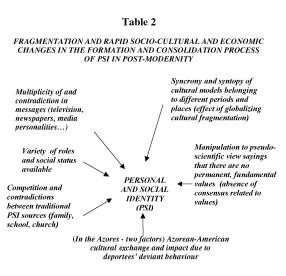
Aires Gameiro, 2001.
1.
The multiplicity and contradiction of
messages and the conflictual dynamic relationship between opinion groups,
pressure groups and behavior have never had so much impact and so simultaneously.
The media, television, cinema, theatre, shows, advertising, newspapers, and the
Internet are seen as sources of identity in competition with the traditional
sources and propose contradictory cultural fragments simultaneously. Children
and young people are subject to unstable, dissonant and incoherent models.
2. The synchronicity and syntopy of different cultural models from different times and places characterizing this Post-modern period are another factor to consider. Layers of cultures from distant times and places compete with the cultural matrix of a people, fragment models and lead to freedom, pressure and anxiety. All who live in cities and villages are pressured by this information and by mobility to live according to culturemas1 from different periods and countries.
3. Competition exists between the various traditional sources of personal and social identity. The family, school, religious group and acquaintances exist on a par with synchronic layers of other different cultures. These contradictory culturemas make the sedimentation of personal identity difficult. The various sources of identity referred to function without consensus and in conflict, often creating insurmountable barriers to the identity process.
4. More serious problems appear when peer group pressure manipulates young people in order to make them think that it is scientific and fashionable to change everything and accept the view that no foundation of permanent values exists.
5.
In the Azores, this fragmentation and multiplicity of cultural content
has been intensified with the increasing interchange between the nine islands
and those from the tenth one living on the other side of the Atlantic Ocean. In
addition, about 500 Azoreans with North American culture have been deported to
the Azores, many of them affected by several genetic frailties and with
deviational behavior.
All
of these rival sources of identity affect children and young people on a daily
basis. We must not forget that about 5 to 10% exhibit fragile identity due to
genetic, family and environmental factors, which make them more conformist and
more easily manipulated and which influence the identity formation of their
partners in a negative way. We can conclude that, today, most children and young
people grow up with more opportunities. At the same time, however, there has
been an increase in risk factors, such as cultural conflicts, psychological
insecurity, stress in decision making and problems of consumption and substance
abuse.
2.
Current Cultural Opportunities and Risk Factors for Women
All of these situations are having an even greater impact on women. Being a woman was never subject to so much change. Women have never had so many different roles available to them (See Table 3).

Aires
Gameiro, 2001.
The
most visible effects of everything we have resumed so far are multiple:
1.
More social freedom. More options. More opportunities.
2.
More strategies for identity development and belonging within society.
3.
More pressures in more directions for
a larger number of social roles.
4.
More favourable changes leading to personal and social development.
5.
More masculine developmental and occupational models available to women.
The
other side of the coin is also unavoidable; more options bring more risks. (See
Table 4) Some of these are:
1.
Hesitation and perplexity when facing decision making
2.
Emotional insecurity
3.
Stress and attempts at identification
4.
Instability in belonging
5.
Being more pressured and manipulated
6.
Being conditioned and in the position of a robot
7.
Evasion and risky consumption

Aires
Gameiro, 2001.
Who am I? What am I going to do with my life? I feel insecure.
The
etymology of the word stress comes from the Latin “stringere” and “strictum,”
which mean to press and refer to the condition of a person being pressed. This
can be defined as the bio-psycho-socio-spiritual condition of those who live
under prolonged tension and conflict and can no longer return to their initial
state of being. In the long term, the result is exhaustion, burn out and loss of
health. Stress can result from what is unexpected or uncontrollable, or from the
person’s way of being (personality). Stress starts when the person is no
longer able to deal with the problem.
Emotional
instability, identity conflicts, insecurity and the continuous efforts to find
satisfactory personal and social identity frequently result in stress in
adolescents, young adults and adults. Today, this stressful condition is
aggravated by the continuous fragmentation of culture, which results in pressure
to make new choices in the face of multiple, unexpected situations.
For many, returning to their initial state before stress set in becomes a
problem which affects their health.
The
person with an unstable identity quickly falls prey to stress and becomes burned
out. When a genetic predisposition exists, as happens in 5 to 10% of persons
affected by stress, the capacity to adapt satisfactorily is even more reduced or
suppressed and the disturbance emerges.
Female
adolescents and young adults today, maybe more than the males,2 are constantly
asking themselves: who am I, what is my place in the family, in society? The
struggles of feminists movements, along increasing opportunities, provoke
perplexity, insecurity, difficult decision-making and problems of belonging. How
should I behave? What’s the right job for me? What should I wear, when, where?
How should I be a woman today? These choices can accentuate problems of identity
and stress.
The
wider the range of choices is, the more uncertain and insecure the person feels.
A silly example would have to do with the choice between wearing a skirt or
pants. When the only option for women was skirts/dresses, they felt more secure
than when the choice became one skirts/dresses or pants. Today, some women have
already found themselves, while others are still looking for their self-image.
Other
examples would have to do with the sexual identity of women before and after the
separation between the sexual and procreative dimensions, or between the
alternatives to either work at home or outside the home, to pursue a college
degree or not, etc. The increase in alternatives available implies opportunities
and advantages, but also implies the cognitive and emotional costs of making
those decisions. Do what? Be who, for what and for whom? Before, the choices,
meanings and directions were fixed. Now, each one has to give meaning and
direction to life. Even if one is
not aware of it, emotional stress is very strong in the process of decision
making.
Emotional
complexity and stress increase in relation to cultural fragmentation and the
choices available. The weight of the choice falls upon the individual, except
when the adolescent or young adult falls into robot-like behavior and does not
take on responsibility, conforming to their partner or peer group and letting
them take control.
Conscience:
A Guide or a Brake That Sometimes Doesn’t Work
When making a choice, the female adolescent is usually alert to such
questions as: Who do I follow? With whom should I conform? For how long? With
what risks? She is living at the crossroads of choices involving “consumer
culture,” “group consumption” and risky consumption. In such conditions,
the capacity to discern critically is put to the test.
By aligning moral conscience to cognitive and emotional capacities, most women choose that which contributes to a positive identity based on self-esteem and a valid project for development. In minor cases, these capacities are reduced and dominated by group pressure and by the attempt to avoid feeling bad or ashamed for not belonging if she doesn’t conform to the group, and this if can be truly devastating when risky behavior is involved. In this way, young girls and boys are caught between the proposals and pressures of groups when it comes to:
1.
Cultural and developmental change, leading to positive personal identity.
2.
Stagnation and cultural rigidity that threatens positive identity
development.
3.
Behavior that is evasive, deviant and risky.
Cultural
change leading to personal and social development and to the economic and
political promotion of women, point to adequate choices to be made. There is,
however, an overabundance of deviant behavior leading to hesitation: Work inside
or outside the home? Proceed with studies or stop early? Become involved in
society or remain passive? Experiment with risky behavior or not? Follow the
example of my mother, my aunt, or this friend and colleague? Follow models of
balanced development or those involving drugs, alcohol or tobacco?
Problems
become more acute in personalities suffering from genetic, environmental,
intellectual and emotional problems. One of those conditions, for example, is
described by Antonio Damásio (5th ed. 1995 p. 221-230)3 as having “a myopic
view of the future” in order to explain the behavior of “individuals under
the influence of alcohol and other drugs.” These persons are controlled by the
present and are insensitive to the future. We can say that cultural conditions
lead a considerable minority of young people to function according to this
weakness, and end up being led to problems of dependency on tobacco, alcohol or
drugs.
3. Stress and Risky Consumption in Azorean Women
Let
us now consider problems related to the consumption alcohol, drugs, and tobacco,
with special emphasis on alcohol. In this respect, women appear as being
victimized by the consumption of others and of their own consumption, and as
victimizers of others due to their own consumption. It is difficult to say
whether women today suffer more from their own stress and risky behavior, or if
they are more in a position of being victims of the aggressive and risky
behavior of others. It is more probably, as we will see, that they are more
often than not the victims of the alcohol and drugs abuse of others, and more
victims of their own smoking habits and of aggressive behavior toward their
children. There is, nonetheless, an overabundance of situations in which their
abuse of alcohol hurts their children, especially during periods of pregnancy
and breastfeeding.
Traditionally,
however, men have been more prone to aggressive behavior, possibly due to
genetic weaknesses and to the macho tendencies of a patriarchal society than to
defending female victims. Almost everything seems to impede these victims from
defending themselves and finding alternatives leading to liberation and
self-fulfillment.
There
are increasing signs that some changes are occurring, at times amidst stress,
personal identity dilemmas, pressure groups and risky choices, and sometimes
with no return possible. While adult women tend to take refuge in the past and
stay in situations where they are victimized and under stress, young women,
along with being victims, tend to react by evading and selling-out their future
through risky behavior and consumption.
Recent
Data About Risky Consumption on a National and Azorean Level
We are only beginning to do research in terms of the effects of alcohol
on third parties, especially women and children. The data is still scarce and
dispersed. The effects of smoking on non-smokers is the area that has been most
studied, while studies on alcohol involve more and more research projects. Drug
abuse has been the most visible area and the one attracting the most funding.
Not being able to review all of the material, I will present some data
pertaining to the Azores in relation to alcohol, tobacco and drug abuse.
ALCOHOL
1.
Alcoholics
Anonymous Questionnaire. 25
to 30% of AA declare that they jeopardize themselves and jeopardize others.
A
recent poll conducted by Alcoholics Anonymous (1999) included 413 members from
70 groups in all of Portugal, including the Azores and Madeira Islands,4 presents some pertinent data (See Table 5). Of the 413
interviewed, 94 were women (23%) and 314 (77%) men, which gives us a ration of 3
to 1. Boys began to consume alcohol at an earlier age, that is 55% before the
age of 17, while 23% of the girls also started before 17 and 58.6% after 20. Of
the women, 25.5% and 34.8% of the men indicated that their reason for starting
to participate in AA meetings had to do with family presure, indicating that
they were already jeapordizing the family. On the other hand, 31.9% of the women
and 19.7% of the men indicate emotional problems, while 8.5% of the women and
9.1% of the men point to physical deterioration.
Table 5
AA Study1999
N=413
M=314
F=94
77%
23%
M %
Age F %
Introduction to alcohol
55
Before 17 23
Problems
15
Before 20
8
Reasons for going to AA:
- Family pressures
34.8
25.5
- Emotional degredation
19.7
31.9
- Physical detereoration
9.1
8.5
Source: E. Serviços Gerais de AA.
2. Alcoholics under treatement. From a small sample of 100
alcoholics undergoing treatment in the center where I worked until 1998, the
majority recognized alcohol as a co-factor in their family’s problems. (See Table 6).
Table 6
Awareness of 100 alcoholics under treatment having the
notion that they provoked problems
to their
families due to their dependency5 in the 80’s
Status
Single
22%
Married
62
Divorced
9
With children
66
Problems
Family problems
94
and
Jealousy in terms of wife
29
Prejudices
Forgets the family
54
Makes the family unhappy
92
Separation due to drinking
33
Note: The % are equal to absolute values.
Source: Aires Gameiro, 1994.
3. About
5.0% of male alcoholics in the Azores jeopardize their wives and children.
In the study we conducted in the Azores in 1999,6
only 5.0% of alcoholic men declared that their drinking affected others. Of
these, 70% indicated their wives and 20% indicated their children as being
affected. On the other hand, only 1.8% of women alcoholics admitted that they
affected their husband and children, their parents and siblings. In both cases,
it is probable that these numbers are underestimated for reasons of self-defense
and negation of the problems, both very common in problems of dependency.
The Alcohol of the “Aggressors” as Seen by Victimized Women
1. About
6.72% of women in national study were victimized due to the alcohol abuse of the
aggressors.
In the Study Alcohol and the Family (EUROCARE-SAAP/COFACE-CNAF
1997), there is a study (Violence Against Women 1997 p.87-89) with samples
representing 1,000 women above the age of 18 in which the victims declared that
16% of their aggressors consumed alcohol and 84% did not consume. When asked if
there was a relationship between alcohol or drug abuse and the violence they had
suffer, 42% responded affirmatively and 10% said they didn’t know, which
results in 6.72% of those victims having perceived the relationship.
2. About
50% of the SOS victims were the result of alcohol abuse.
In terms of 80 women assisted by SOS Vitima (Angra
2001), the aggressor is a male alcoholic in 50% of the cases, and dependent in
9% of the cases, with no indications as to whether the victims perceived the
relationship to alcohol and drugs (See Table 7).
Table 7
Alcoholic Agressors in a Group of 80 Cases
S.O.S.
Vitima (Angra, March 2001)7
Characteristics of the Aggressor
N
%
Alcoholic
40
50
Behavioral Problems
25
31
Drug Dependency
7
9
Adultery
6
8
Handicapped
2
9
TOTAL
80
3. About
6.5% of Azorean women are victims of alcoholic aggressors.
In the book The Situation of Women in the Azores
(1999), 6.5% of the 2000 women recognized some relationship between the violence
they suffered and the alcohol problems of their aggressors. This percentage is
near the 6.72 referred above. From this study, we include Table 8 (p.185).
Table 8
Relationship Between Violence Suffered and Alcohol and
Drug Abuse8
Itens
%
Often
1.6
Sometimes
2.9
Seldom
2.0
Never
21.3
Don’t Know/No Answer
72.2
TOTAL
100.0
Source: Situation of Women in the Azores, 1999.
As the authors state, the high percentage of 72.1% of the women who do not know or do not respond, pointing to a “reserved attitude,” means that this can not be understood as lack of knowledge or perception. In our estimation, these point to the tendency to negate, hide and feel ashamed of the situations in which they find themselves due to affective ties or to their own substance abuse. When the questions pertain to less affective issues, the percentages pertaining to these same women are much higher, 62.9% totally disagree with alcohol and 27.7% simply disagree, a total percentage of 90.6% (p.69 and 70). The authors point out that “Alcoholism is more prejudicial, perhaps it has been more a part of the daily life of many women because of their husbands, fathers, brothers or other close acquaintance.” (p.69-70) and that “We know how alcoholism in women of all ages, including adolescents and children, has increased in the last few years.” (p.70) Based on the last three sources, we can conclude that about 5-7% of women are beaten by their husbands because of alcohol.
4. 10%
of aggressions against women are due to alcohol
In a telephone interview, 200 women from São Miguel
Island (See Table 9 for technical information) were asked about their own habits
in terms of alcohol consumption and the consequences, and were also questioned
about the habits of their male partners and the results of this behavior.
Table 9
Drinking Habits of Women Who Consume Alcohol
in
São Miguel (2001)
Technical Information
Author: Aires Gameiro
N=200 women living 15 or more years in the Island of
São Miguel
Date: May 19 and 20, 2001
Method: Telephone interview (73.1%) (27% of the homes
were excluded because they had no telephone)
Margin for Error: +- 6.9
Interviews and Calculations: Norma-Açores
Sponsorship: Instituto S. João de Deus
Of the 200 women, 43.5% admitted to consuming alcoholic
beverages and 73.5% to having a husband, companion or boyfriend who consumes;
54% of these last women also drink. (See Table 10). The level of consciousness
women have of the damage brought about by their own consumption and by that of
their husbands is indicated in Table 11. In all, 19.6% of the consumers feel
that alcohol is prejudicial to their health, (17.2%) to their lives, and (5.7%)
to the lives of their family members and others (1 to 3.5%).
Table 10
Women and Alcohol in São
Miguel Island
N=200
Aires Gameiro, Jun-01
Women
%
Husbands
%
Consume
43.5
Have a husband
73.5
Do not consume
56.5
Do not
26.5
Husbands consume
40.0
Do not consume
33.5
Total
100.0
100.0
Of the 73.5% who have husband
Consume
54.0
Do not consume
46.0
100.0
Of the husbands who drink (54%), 26.2% are perceived by
the women to be prejudicial to: his health (25%), to her health (10%), 7.5% to
the children’s health and 3.8% to the life of others. The conclusion was that
10% of the alcoholic aggressors cause some kind of damage to women due to
alcohol.
Other Results of this Study
In the area of Ribeira Grande, 45% drink and 33.4% of
the women state that this is jeopardizing their health and 14.3% the life of
others, while in the Lagoa area 41.2% drink and 14.3% declare this to be
prejudicial to their lives. The husbands who drink in the City of Ribeira Grande
(42.5%) are the ones who are seen as jeopardizing their health most, 23.5 as
jeopardizing the woman’s life and the family. The highest percentage seen as
not jeopardizing (47.1%) also occurs in Ribeira Grande.
In terms of schooling, women with Higher Education are
those who consume alcohol most, at 80% and 53.8% for those who have attended
junior high school. In accord with this, 50.0% of their husbands with similar
educational levels also drink
Table 11
% of Women, Husbands and
Alcohol in São Miguel
(Awareness of the
Consequences)
N=200
Aires Gameiro, Jun-01
The 43.5% of Female
The 54% of Drinking
Consumers
Husbands
Who Jeopardize
Who Jeopardize
%
%
Her health
17.2 (1) His health
25 (1)
Her life
5.7 His
life
10
The husband’s life
1.1 His
life
10
Other family member
3.4 The
childrens’ life
7.5
Other persons
2.3 The
life of other persons
3.8
Do not jeopardize
78.2 Do
not jeopardize
72.5
Don’t know/ Don’t answer
2.2 Don’t
know/ Don’t answer
1.3
Total: No answers
80.4 Total:
No answers
73.8 Total
yes answers 19.6 Total yes answers
26.2
(1) Multiple Answers.
Source: Aires Gameiro, 2001.
Urban areas (Ponta Delgada and Ribeira Grande) present
the highest percentages of female consumption of alcohol, at 52.6%, compared to
39.9% in rural areas. However, when it comes to the smaller villages, women
drink even more (62.5%) with an average of 43.5%.
Note: All
of this data may be below real levels since 27% of the homes were not included
because they did not have telephone service.
Table 12
Summary
1.
From the total number, 43.5% of the women, and 54% of the husbands drink.
19.6% of the women who drink put themselves or their families in jeopardy, while
the percentage for men is 26.2%, with 10% jeopardizing their own lives.
2.
While of the women who drink, only 1.1% admit to jeopardizing their
husbands, 10% recognize that their husband’s drinking jeopardizes them. We
have here an assymetrical ratio of 1 to 10.
3.
The city of Ribeira Grande, followed by Lagoa, present the highest
percentages of those who jeopardize themselves and others. The highest
percentage of husbands who jeopardize their wives, children and other family
members occurs in the city of Ribeira Grande.
4.
On the other hand, it is the women
and husbands with a university level of education, followed by the junior high
level, who drink more and jeopardize their own health the most.
5.
And, finally, it is in the urban areas of Ponta Delgada and Ribeira
Grande where women consume the most alcohol, but it is in villages with less
than 1,000 inhabitants that the highest percentage of women who drink alcohol is
registered.
24.5% of the men and 28.8% of the women in the Azores drink too much.
In a study from 1999 representing 550 participants who
were 15 years old or older, we came up with the following results:
1. If
we consider the habit of consuming 6 to 9 alcoholic drinks per week, we come up
with Table 13.
Table 13
Azores – Alcoholic Consumption
Consumes
Drinks
M
F
Ratio M/F
Per Day
% %
2 to 3 times week(1)
1
23.4
7.7
3.0/1
1 per day
3
16.2
2.8
5.7/1
3 to 5 times a day
3 to 15
8.3 0
8.3/1
Total
47.9 10.5
5.0/1
(1) Average
of 3 drinks each time.
Source: Aires Gameiro, 2000.
Even if we consider that
women become intoxicated with about half the consumption of men, and that three
drinks per day is already excessive drinking for women and for many men, only
2.8% of Azorean women abuse alcohol, compared to 24.5% of men, that is, about
1women to 8 men.
2.
The same study indicates the numbers of those who have never consumed
alcohol or quit and the reasons. (p. 44 and 64). (See Table 14).
Table 14
Azores – Have Never Drunk or Quit
M
F
Ratio
%
%
M/F or F/M
Never
9.8 30.5
3.1/1
For health reasons
23.1 50.6
2.1/1
Quit more than 10 years ago
14.4 10.2
1.4/1
Do not like
10.5 24.1
For health reasons
84.2 75.9
1.1/1
Source: Aires Gameiro, 2000.
For every male, 3 women totally abstain from drinking
alcohol due to health reasons and recognizing that they are more sensitive to
the damages of alcohol. The reasons for The reasons for quitting have to do with
health and with not liking drinking. Women are most sensitive to health reasons,
indicating that they may have quit because their health was already affected.
3. There is a great disparity between the opinions of
men and women with respect to the number of cups/day that do not have negative
effects, as seen in Table 15.
Table 15
Azores – How many cups/day do
not have negative effects?
Cups/Day9
M F
M F
% %
% %
1 cup/day
30.9 40.7
1 23.4
7.7
3 cups/day
14.0 6.0
3 16.4
2.8
4 and 5 cups/day
6.8 1.4
4 to 15 8.3 0
It’s impolite to refuse alcoholic drinks?
13.6
6.7
Last drink: today
29.1 4.5
Total
47.9 10.5
Source: Aires Gameiro, 2000.
This difference between men and women is also apparent
in the answers about whether refusing alcoholic drinks is impolite and about the
last drink consumed that day.
TOBACCO
28.6% of men and 26.6% of women smoke.
According to the same study (Aires Gameiro 2000), there
is a difference between alcohol consumption and the use of tobacco by women, as
can be seen in Table 16.
Table 16
Azores – Use of Tobacco
T
M F
Ratio Young People
%
% %
M/F 15-17
18-24
Have smoked
42.2 63.4
22.5 2.8/1
22.7 50.6
Continue to smoke
28.0 28.6
26.6 1.1/1
20.0 29.5
Source: Aires Gameiro 2000.
According to this table, we can see that 2/3 of males
and 1/4 of females 15 and over who have alredy smoked, about 3 men to 1 woman.
Of these, about one quarter continue to smoke. This seems to indicate that
smoking is more accepted by women and that it has become fashionable among young
women as a way of self-affirmation.
These numbers are different from the 15% of women in a
1990-1992 study conducted in Portugal by OMS-Europa10
which also registered a tendency for the use of tobacco to decrease among men
and to increase among women (p.11). At the same time, this study presents
similar findings for 12-18 year olds, with equal rates for boys and girls until
the age of 16 (p.13), that is, 8.2% for
12-14, and 22.7% for 15-16,
A national study11 from 1997 indicates that in Portugal
38% of men and 9.0% of women had smoked during the last month, with a percentage
of 24.2% of young people of both sexes between 15-24. These are finding which
show that the 1999 findings for women in the Azores are significantly above,
while the findings for men are below the national average. The 15-17 year olds
and the 18-24 year olds continue to demonstrate smoking levels near the national
average.
DRUGS
1.15% of Azoreans Consume Drugs.
Obtaining reliable data about drug abuse continues to
be difficult. We have tried to organize the data that follows.
1.
In the study already referred to (Aires Gameiro 2000), data was collected
without separating men and women, as seen in Table 17, which indicates
consumption of any kind of drug. If we consider those over 15 years of age, we
have 13,400 who have already consumed and 2,170 for those who declare that they
still consume some kind of drugs, except alcohol or tobaco.
Table 17
Azores (1999)
Consumption of Any Type of Drug
%
Population
Have consumed
6.7
13.400
Still consume
1.15
2.170
Source: Aires
Gameiro.
2. Considering first-time hospitalization of men and women, who are drug
addicts, we find that in 1998, 1999 and 2000, 248 men and 33 women came to Clínica
S. João de Deus to be treated, which results in 7.5 men for every woman. Heroin
users look for treatment most often. We are not including those treated in
out-patient care. (See Table 18).
Table 18
Clínica
S. J. Deus/Casa de Saúde S. Miguel
HOSPITALIZATION DUE TO DRUG ABUSE
PERIOD: 1991-2000
MASCULINE
FEMININE
TOTAL
1 time
2 t. Total 1 time
2 t. Total
1 time 2 t. TOTAL
1991
5
1 6
0 0
0
5
1
6
1992
1
0 1
0 0
0
1
0
1
1993
7
0 7
0 0
0
7
0
7
1994
14
0 14
0 0
0
14
0
14
1995
8
1 9
0 0
0
8
1
9
1996
6
4 10
0 0
0
6
4
10
1997
23
4 27
0 0
0
23
4
27
1998
62
7 69
11 3
14
73
10
83
1999
88 30 118
13 8
21
101 38
139
2000
98 67 165
9 21
30
107 88
195
TOTAL 312 114
426
33 32
65
345 146
491
We began a
Methadone treatment in January of 2000 for 131 men and 17 women. Of those who
started then, 84 men and 7 women remain, while 57 men and 10 women dropped out.
In terms of deportees, 51 men and 11 women, a total of 62, were hospitalised at
the Clínica S. João de Deus. This number represents about 1/6 of the total of
deportees now in the Azores.
3. We
will now summarize the data collected by the Special Committee of the Regional
Legislative Assemby, May 2000, and compare these findings with our study. (Please
see summary Table 19 by institution, and Table 20 by island).
Table 19
Numbers Referring to Drug Consumption from the Report
May of 2000 - the
Regional Legislative Assembly12
Entities
and
Average
Average
Type of
Institutions
M Age
F
Age
T
Drug
Schools
Parent Associations
12
15-20
9
14-16
21
hax/alc
Private Institution for
4
60
9
70
13 alc
dep/her/coc
Social Solidarity (IPSS) 40 (18)(1)
30
8
29
48
Health Centers
230
20-25
71
22
301 her/coc/hax/alc
Psychiatric Hospitals /
Health Centers
272
25-30
57
20-30
329
her/coc/hax
-17(2)
Police Stations / Prisons
166
Social Institutions
-45(3)
25-30
10
20-30
176
her/hax/coc
Total de M + F less
those repeated
644
156
880
(1)
18 sent to Clínica S. João de Deus.
(2) 17 seen by other doctors or sent to Clínica SJD/Casa
de Saúde S. Miguel.
(3)
45 sent to C.S.J.D./Alternativa/C. Saúde da Horta.
Comparing
Estimates
Table 21 compares the estimates from our October 1999
study with the data obtained by the Special Commission in May of 2000.
Table 20
Distribution of Drug Users According to Islands
M
F
T
Type of Drug
S. Miguel
331
52
383
hax/alc/coc/her
Terceira
357
98
455
hax/her
Faial
21
4
25
hax/her
+20(1)
Pico
2
1
3
hax/coc
Flores
3
-
3
-
Total
714
155 869(2)
+20
(1) 20 not specified as M and F.
(2) We were
unable to adjust this figure with that of the previous Table.
Table 21
Comparison of the Data from the 1999 Study
With those of the Special Committee in 2000
M
F
T
Pop.
%
October 1999 Study
Consume
-
-
6.7
12.750
Aires Gameiro
Still consume
1.15
2.170
Report of Special Commssion,
644
156
800
800
May 2000
0.34% 0.08%
0.42%
From these results, we can safely conclude that:
1.
The “generic” drug abusers (present
poli-consumers) in the Region between from 1999 to 2000 numbered about
2,200.
2. The Report of the Special Commission
detected less than 50% because these were the ones who sought help.
3. We can then estimate that at least
1.15% of the population of persons 15 or older consumed in 2000 and about 6.7%
had experimented.
4. For
each female consumer, we estimate four males.
These figures are probably
below the real figures.
More Research Is Needed
It is necessary that more research be conducted in
order to reach a more objective analysis of the relationship between the
victimizer who consumes alcohol and violence against women, so that we can
discriminate between the various factors involved. More research should be done
in the following areas:
1. presence of alcohol.
2. quantity consumed and
effects.
3. relationship to the
co-factor of aggression and violence.
4. type of aggression
and abuse.
5. awareness of the
relationship between drinking and its consequences.
6. awareness of the
relationship between the aggressor’s drinking and the violence suffered.
Final Considerations
1. To the common “lack of perception and tendency to hide the violence,”13 we would add the sense of shame and taboo associated with having a problem of alcohol affecting the family, the husband or the father.
2.
The representations of women vary according to the consumption of alcohol
and the alcoholism of the man, depending on whether the woman feels that she
cannot live without the man or that she can no longer put up with him.
3. An important factor has to do with women themselves consuming excessive alcohol and living with this problem. The tendency to deny also alters their perception. The emancipation and economic independence of women is increasing the number of women drinkers, making them more tolerant of aggression resulting from alcohol.
4. There remains a need to clarify what levels of alcohol consumption are prone to cause problems in terms of the family and women, as well as what the levels of tolerance are, what the expected effects of alcohol are, and what is seen as acceptable/not acceptable in terms of drinking by men. The relationship between violence and alcohol can lead one to think of excessive consumption and drunkenness, or of light / Social drinking which alters moods and reactions. The drinker with epileptic tendencies or with psychic disturbances can become drunk or affected when medication is stopped or mixed with alcohol, even in small quantities.
5. Ideas about alcohol must also be considered in terms of those who drink in excess or in a dependent way, even when their behavior is altered, for neither they nor those around them discern any problem unless they become completely drunk. Women also deny their husband’s drinking problem until the family’s money disappears, changes in personality become repeated and threats and abuse increase. Even then, many women will continue to deny their spouse’s problem because of shame.
6.
The perception of being a victim or not varies according to the concept a
culture has of violence and to levels of tolerance. Does it include physical
abuse, abusive language, or only physical aggression that leaves marks on the
body? It can even be interpreted as not being violent by the woman who says,
“My husband doesn’t beat me, and if he ever does, it’s because I deserve
it.”
While
it is true that alcohol can be used as an alibi for men and women to excuse
their inadequacies and to relieve tension, we must not forget that many of the
small-big problems with alcohol start precisely when drinking relieves tension
and awakens emotions. We may conclude by saying that more research is necessary
so that we can have a better idea about the dimensions of the damages caused by
smoking, drinking and drug use to those who do not partake of these intoxicating
substances, but are exposed to these types of behavior.
Bibliography
A.A.
Sondagem aos Membros de Alcoólicos Anónimos, Outubro de 1999. Lisboa:
Escritório de Serviços Gerais,1999.
CANÇO,
Dina and CASTRO, Isabel. (2000). Portugal:
Situação das Mulheres 1999, 15ª edição CIDM.
CANHA,
Jeni. (2000). Criança maltratada. Papel
de uma pessoa de referência na sua recuperação. Coimbra.
COMISSÃO Nacional da Pastoral da Saúde. Mulher
Informada. Maternidade Saudável – Desafios e Propostas, Lisboa.
DAMÁSIO,
António (1995). O erro de Descartes. Emoção,
Razão e Cérebro Humano, 5ª edição. Lisboa.
EDWARDS,
Griffith, ANDERSON Peter et al.
(1997).
A Política do Álcool e o Bem Comum. Lisboa.
GAMEIRO
Aires et al. (1988). Pessoas
Dependentes (Drogas, Álcool...). Ed. Hospitalidade and Cáritas.
GAMEIRO,
Aires, MOREIRA, Mª João, CARVALHO, Gualter de, and RUIVO, Mª José. (1998).
Alcohol Problems and the Family Report, SAAP.
GAMEIRO,
Aires. (1983). Álcool, Alcoolismo e
Drogodependência – Recuperação através da reestruturação
inter-relacional e sistémica. Lisboa: Ed. Hospitalidade.
______Alcoolismo
na Interacção Sistémica - Aspectos psicossociais da Alcooldependência – Editorial
Hospitalidade, 1981.
______Alcoolismo
nos Açores e Madeira. Padrões de consumo em 1999 e 2000. Linhas de Prevenção.
Lisboa: Ed. Hospitalidade, 2000.
______Emigrantes.
Psicologia Social, Conflitos e Desafios Culturais. Lisboa:
Centro do Livro Brasileiro, 1984.
______Hábitos
de consumo de bebidas alcoólicas 1995, 1991, 1997, Lisboa:
Ed. Hospitalidade, 1998.
______Liberdade
de beber e de não beber. Saúde e pressões relativas ao consumo de destiliados,
cerveja e vinho. De colaboração com o Dr. Saturnino e outros. Lisboa,
Ed. Hospitalidade, 1987.
______Lusofonia
e Identidade na Diáspora. Análises psicossociais. Lisboa:
Ed. Paulinas, 2000.
______Manual
de Saúde Mental e Psicopatologia. Guia Prático de acompanhamento na Saúde
Mental e na Doença Nervosa. 4ª Ed. de “Psicopatologia e Saúde Mental”, with
five chapters on Social and Community Psychatry. Porto:
Ed. Salesianas. 1989.
______Novos
Horizontes da Viuvez. Crise, Acompanhamento, Psicologia, Novo Projecto e
Pastoral. Lisboa: Ed. Paulistas,1988.
HARKIN, Anna May, ANDERSON, Peter and GOOS, Cees.
(1997).
Smoking, drinking and drug taking in the European Region. Copenhagen:
WHO Europe.
JUNAAB.
(1997). AA Para a mulher, 7ª ed. Portugal.
LAY, William & RUTHERFORD, Derek. (1998).
Alcohol problems in the family. A report in the family. England.
LOURENÇO,
Nelson, LISBOA, Manuel & PAIS, Elza. (1997).
Violência contra as mulheres na família – caracterização das representações
sociais e práticas de violência em relação à mulher. Lisboa: CIDM.
MCNEILL,
Andrew. (1999). Medical
Education in Alcohol and Alcohol Problems, EUROCARE: England.
MENDES,
Maria Fernanda. (2000).
Relatório sobre a problemática da droga na Região Autónoma dos Açores. Ponta
Delgada.
PLATON,
Alex. European Alcohol Action Plan, WHO
Copenhagen 1993.
ROCHA,
Gilberta, MEDEIROS, Octávio, TOMÁS, Licínio, MADEIRA, Artur and BORRALHO, Álvaro.
(1999). A Situação das mulheres nos Açores.
Ponta Delgada.
RODRIGUES,
Luísa, MENDES, Zilda and ANTUNES, Carla. (1997).
(ESPAD) Inquérito a Alunos do Ensino Secundário: Portugal 1995. Lisboa.
STEELE, C.M and R.A. Joseph (1990).
“Alcohol myopia” in American Psychologist 45: 921-33. Cited by António Damásio
(1995).
____________________
*
Participated in the Conference A
Mulher nos Açores e nas Comunidades, July 16-18, 2001, University of the Azores.
 Homepage Forschung-Übersicht
Seite oben
English texts
Homepage Forschung-Übersicht
Seite oben
English texts


