Zusammenfassung
von uns:
Die
Arbeit untersucht eine Anzahl vorhandener Berichte, die bisher nur geringe
Auswirkungen auf den Gesamtalkohol-Konsum auswiesen und teilweise die
These der Industrie unterstützten, dass diese Werbung nur zur
Verbesserung der Marktanteile einer bestimmten Marke dienten
Die
kritische Auseinandersetzung mit diesen Untersuchungen und eine neue
Fragestellung führten zu neuen, an sich logischen Ergebnissen, die von
der Präventionsseite schon immer so gesehen wurden. Jetzt kommt hier die
längst fällige Beweisführung, die auch Politiker überzeugen können
sollte. Hier die Schlussfolgerungen:
.."-
Es gibt einen empirischen Nachweis für begrenzte Effektivität
- Insgesamt wurden zwei bis vier gut kontrollierte Studien zur
Effektivität
durchgeführt
- Die Strategie wurde bereits in mehreren Ländern erfolgreich
durchgeführt
- Die Kosten zur Implementierung sind relativ niedrig"
In
einem Abschnitt zur Selbstregulierung der Industrie kommt der Verfasser
zum Schluss, dass Werbeverbote immer noch wirksamer sind als diese
Selbstkontrolle.
Der
Argumentation der Industrie, dass die Beweise zu wenig stichhaltig seien,
tritt er mit dem allgemein gültigen Public Health Prinzip einer
"Vorsorge aus Prinzip" entgegen, das auf alkoholpolitische
Massnahmen, wie das Werbeverbot, voll zutreffe. Das bedeute,
"-
dass präventive Massnahmen auch ohne definitive Gewissheit zu ergreifen
sind
-
dass die Beweislast bei den Befürwortern einer potenziell
schädigenden
Verhaltensweise liegt
-
dass Alternativen zu schädigenden Verhaltensweisen anzubieten sind, und
-
dass die Öffentlichkeit verstärkt in den Entscheidungsprozess über
politische
Massnahmen miteinbezogen werden sollte
Werbe-
und Sponsoringverbote für alkoholische Getränke sollten in diesem Sinne
schon aus Vorsorge für die Gesundheit der Allgemeinbevölkerung wegen der
grundsätzlichen Bedeutung einer solchen Politikausrichtung durchgesetzt
werden."
Kommentar:
Es
ist sehr verdankenswert, dass Prof. Rehm und das ISF sich auch dieser
Thematik angenommen haben, nachdem bereits die Frage der Wirksamkeit der
Besteuerung, d.h. Preisgestaltung geklärt worden ist. Politiker sollten
sich jetzt ihrer Verantwortung bewusst werden und keine billigen
Ausflüchte mehr bringen. Das Radio- und Fernsehgesetz mit der
Alkoholwerbung durch Privatsender liegt immer noch auf dem Tisch.

Summary
by us
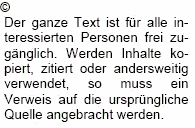
Copyright: The full text is free
available for all interested
persons. Are contents copied, cited or used in an
other way, there must be added a remark about
the initial source.
This
study reviews a number of international research results, which mostly
showed only little effect on the total consumption and some of them backed
the thesis of the alcohol industry that alcohol advertising only helps to
keep or improve the share of the market of special brands.
A
critical examination of those studies and a new way of putting questions
brought new, actually logical results, which had always been regarded in
this way by the public health stakeholder side. Now comes the long due
line of argumentation that should convince even politicians. Here are the
conclusions:
.."-
There is an empiric evidence for limited effectiveness
- Totally two to four well controlled studies regarding effectiveness were
carried out
- The strategy had been successfully realized in several countries already
- The cost for implementing are relatively low"
In
a section about selfregulation by the industry the author comes to the
conclusion that bans on advertising are still more effective than such a
selfregulation.
The
argument of the industry that proofs are not evident enough he replies
with the commonly valuable Public Health Principle of a prevention on
principle, which fully apply to alcoholpolicy measures, as a ban for
advertising. That would mean,
"
- that preventive measures have to be taken even without a definitive
certainty
- that the burden of proof is on the advocates of a potencially damaging
behaviour
- that alternatives to ways of damaging behaviours have to be offered, and
- that the public should be more integrated into the decision
finding process on
political measures.
Bans
on advertising and sponsoring for alcoholic beverages should be enforced
in this sense if only because of preventional reason for public health
because of the principle meaning of such a policy strategy."
Comment:
We
have to thank very much Prof. Rehm and the ISF that they searched on this
problem after the question of the effectiveness of taxing, pricing had
been cleared already. Politicians should become aware now of their
responsibility and stop making cheap excuses. The revision of the law on
broadcasting and television with the possibility for alcohol advertising
on private stations is still pending.
|


 Homepage Forschung-Übersicht/Research

